1-844-900-3647
Destructive chewing!

Destructive chewing!

Chewing

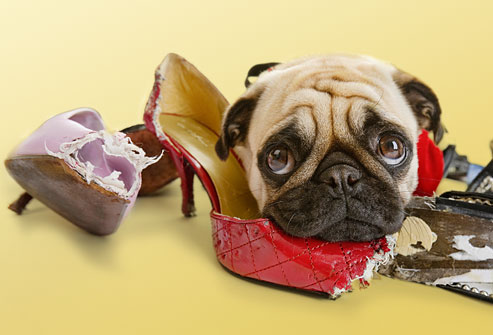
Chewing is essential for maintaining the health of your dog’s teeth, jaws, and gums. Puppies especially have a strong need to chew to relieve the irritation and inflammation of teething. Dogs chew to relieve anxiety and boredom, as well as for entertainment. Your dog’s jaws are his tools for carrying objects and for investigating its surroundings. Essentially, a dog’s approach to all items in his environment is “Can I chew it?”

Chewing is Normal, Natural, and Necessary

Dogs generally sleep at night and in the middle of the day. However, chewing is your dog’s primary form of entertainment during his morning and late afternoon activity peaks. After all, there are only so many things your dog can do when left at home alone. He can hardly read a novel, telephone friends, or watch the soaps! Indeed, most chewing sprees stem from your dog’s relentless quest for some form of occupational therapy to pass the time of day when left at home alone.

Chewing is a perfectly normal, natural, and necessary canine behavior. Prevention and treatment of destructive chewing focus on management and education — to prevent your dog from chewing inappropriate items and to redirect your dog’s natural chewing-urge to appropriate, acceptable, and resilient chew-toys.

Prevent Destructive Chewing

When leaving home, confine your puppy-dog to a long-term confinement area, such as a single room—your puppy-dog’s playroom—with a comfortable bed, a bowl of water, a doggy toilet (if not yet housetrained), and nothing to chew but half a dozen freshly-stuffed chew-toys. Housetrained adult dogs may be confined (with their chew-toys) to a dog crate. When you return, instruct your dog to fetch his chew-toys so you can extricate the freeze-dried liver pieces and give them to your dog. Your dog will happily settle down and entertain himself with his chew-toys as soon as you leave in the morning, and he will be more inclined to search for chew-toys when he wakes up in anticipation of your afternoon return. This is important since most chewing activity occurs right after you leave home and right before you return.

When you are home, confine your puppy to his doggy den (crate) with nothing but a freshly-stuffed chewtoy for entertainment. Every hour on the hour (or at longer intervals with housetrained adult dogs), take your puppydog to her doggy toilet (see Housetraining blueprint), and if she goes, praise her and play some chewtoy games with her before putting her back in her crate with a freshly stuffed chewtoy. The purpose of confinement is to prevent your dog from chewing inappropriate items around the house and to maximize the likelihood your dog will develop a chewtoy habit.

Redirect Chewing to Chew-toys

The confinement schedule described above optimizes self-training; your dog will train herself to chew chewtoys. In fact your dog will soon become a chewtoyaholic. With a good chewtoy habit, your puppy will no longer want to destroy carpets, curtains, couches, clothes, chair legs, computer disks, children’s toys, or electrical cords. Your dog will be less likely to develop into a recreational barker. And also, your dog will happily settle down calmly and quietly and will no longer be bored or anxious when left alone.

You must also actively train your dog to want to chew chewtoys. Offer praise and maybe a freeze-dried liver treat every time you notice your dog chewing chewtoys. Do not take chewtoy chewing for granted. Let your dog know that you strongly approve of her newly acquired, appropriate, and acceptable hobby. Play chewtoy games with your dog, such as fetch, search, and tug-of-war.

Chewtoys should be indestructible and nonconsumable. Consumption of non-food items is decidedly dangerous for your dog’s health. Also, destruction of chewtoys necessitates their regular replacement, which can be expensive. However, compared with the cost of reupholstering just one couch, $70 worth of chewtoys seems a pretty wise investment.

Kongs, Biscuit Balls, Big Kahuna footballs, and sterilized long-bones are by far the best chewtoys. They are made of natural products, are hollow, and may be stuffed with food to entice your dog to chew them exclusively.

To prevent your dog from porking out, ensure that you only stuff chewtoys with part of your dog’s daily diet (kibble or raw food). Firmly squish a piece of freeze-dried liver in the small hole in the Kong, fill the rest of the cavity with moistened kibble, and then put the Kongs in the freezer. Voila, Kongsicles! As the kibble thaws, some falls out easily to reinforce your dog as soon as she shows interest. Other bits of kibble come out only after your dog has worried at the Kong for several minutes, thus reinforcing your dog’s chewing over time. The liver is the best part. Your dog may smell the liver, see the liver, (and maybe even talk to the liver), but she cannot get it out. And so your dog will continue to gnaw contentedly at the Kong until she falls asleep.

Until your dog is fully chewtoy-trained, do not feed it from a bowl. Instead, feed all kibble, canned food, and raw diets from chew-toys, or hand-feed meals as rewards when you notice your dog is chewing a chew-toy.

If you would like better insight into your dog’s chewing psyche, read chapter 3, “It’s All Chew Toys to Them,” in The Culture Clash by Jean Donaldson. If you require a more detailed description of chewtoy training, read our Chewing booklet and BEFORE You Get Your Puppy, and watch the Training The Companion Dog Video II: Behavior Problems & Household Etiquette. To chewtoy train your dog, you need a dog crate, a number of hollow chewtoys, and some freeze-dried liver treats.

——————-

This article was written by Dr. Ian Dunbar;  Published in 2004 by Dr. Ian Dunbar: James & Kenneth Publishers

Dr. Ian Dunbar PhD, BVetMed MRCVS

Veterinarian, animal behaviorist, and dog trainer, Dr. Ian Dunbar received his veterinary degree and a Special Honors degree in Physiology & Biochemistry from the Royal Veterinary College (London University) plus a doctorate in animal behavior from the Psychology Department at UC Berkeley, where he researched the development of social hierarchies and aggression in domestic dogs.
Biking with your dog?

Biking with your dog?

Every dog needs exercise!

Some owners go for regular walks during the day, others will take their dogs to a park and play fetch games with them. There are also some who take their dogs to dog parks and let them play with other dogs, while they get to socialize with dog owners. Some people love running with their dogs and that is what I used to do until I twisted and broke my ankle last summer. My dogs weren’t too impressed with their new lack of exercise… and decided to cause me some grief in their spare time. Digging holes in our backyard, destroying toys in a matter of seconds while unattended and play-fighting to a point of snapping at each other.

I quickly came to realize that I needed to get them occupied in a meaningful way despite my crippled leg. At the beginning, driving to the park and playing fetch worked just fine, especially with Lutz and his never-ending desire to chase after a ball. Funny side story: one day my wife Marie Therese took our kids and Lutz to the playground adjacent to the baseball field where I play fetch with Lutz.  My wife had her hands full with the kids and suddenly realized that Lutz was no longer at the playground! She called him several times to no avail as he wasn’t anywhere to be found. She headed toward the baseball field where she saw Mr. Lutz playing fetch with a man and his ball, while the man’s dog sat and watched. Lutz came over to her side after being called wagging his tail. The kind gentleman, stated that he had a blast playing with Lutz as his own dog (a little Shitzu) didn’t really have any drive to chase after the ball. It just goes to show that Lutz would even go and play with strangers to satisfy his ball drive!

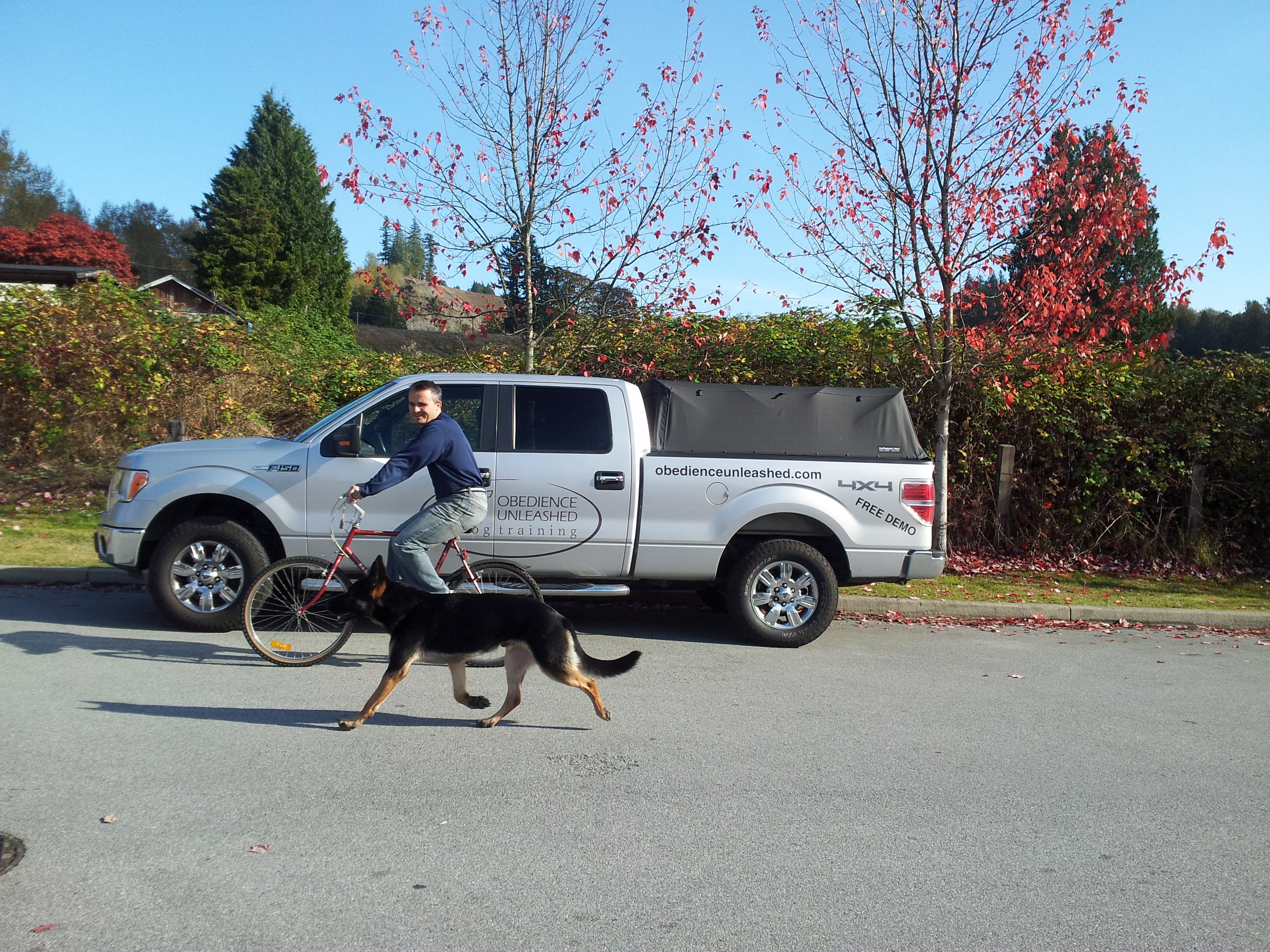
Anyways, when I became somewhat mobile but still unable to run, I decided to teach Lutz and Nika some basic positioning skills for accompanying me on a bike ride. Nika wasn’t much of a challenge as I’ve had her since she was a puppy and she fully understands what it means to heel. Lutz on the other hand caused me to almost drive myself into a parked car. I realized that I had to take some baby steps in teaching him how to properly heel beside my bicycle. Here is how I started:

  1. Walk slowly beside the bicycle while on leash (it took me a few days to get him used to not running in front of my bike). I did lots of reps in a straight line to ensure that Lutz understood what was expected of him.
  2. Lutz heels on my left side by default so I decided to take him for his first slow jog around the block, selecting only right turns in order to avoid the possibility of him cutting me off. He did great and actually quite enjoyed himself. I decided to keep on going at that pace for a while to do some proofing with Lutz, while still leading him on-leash.
  3. Several weeks passed and I decided it was time to change the route on Lutz and take him for a first slow jog while off-leash. I need to say there have been better days!
  4. A few days later I returned to off-leash practice while riding on my bicycle only to find out that Lutz was ready for the challenge. I was able to speed up significantly to a point of a full gallop for Lutz while riding through our neighbourhood and expose him to unexpected cat sightings, which for Lutz are usually very exciting, if you know what I mean. Regardless of the distractions he still heeled beside me off leash.

At this stage, I can take both Lutz and Nika with me for a nice bike ride without worrying about colliding with them. It is a huge improvement from one month ago and an enjoyable form of exercise for the dogs and I.

——

Written by: Andy Krzus

The ‘Place’ command, a handy trick

The ‘Place’ command, a handy trick

Aunt Florence walks through the front door in her Christmas best, only to be bowled over by  Rover, your beloved, overgrown dog who is trying to say “hello”. Does this sound familiar?

We are currently in the thick of the holiday season and many of us will be entertaining guests at our house. You may enjoy your dog greeting you excitedly when you come through the door, however, your guests may not be as thrilled with this sort of welcome.

In this article, I would like to explore a practical trick to teach your dog, it’s called the “place” command. It teaches your dog to stay on top of a “place object” for a period of time until released by you. At the same time, it improves concentration skills and self control.

Here are a few steps to teach the “place” command:

Step 1

  • First of all, make it a fun game for your dog and have his favorite treats on hand.
  • In the initial steps of learning, try to eliminate unnecessary distractions (such as children, other pets or toys on the floor etc.)
  • Instead of spending 30-45 minutes of continuous training with your dog, split it into 3-5 sessions per day of 5 minutes each.
  • Choose a “place object” that your dog can comfortably fit on, such as a floor mat or dog bed.
  • With your dog at your side place a small treat on top of the “place object” and invite him to go to his “place” while pointing to it. When he gets there he will be able to get his treat.
  • Repeat this exercise as many times as it takes for your dog to learn what you want from him. It takes a dog 30-80 repetitions to learn a new command, so be patient.
  • Important note: your dog gets rewarded only while on top of his “place”.

Step 2

  • Ask your dog to go to his place without placing a treat on it and reward him immediately when he gets on top of it (we’re not working on duration yet).
  • Start introducing distance gradually by taking a step or two away from the place.
  • Once you’re standing farther away you can simply toss the treat on top of the place, next to your dog instead of walking toward him.
  • Try this fun variation: Once they learn the “place command” you can also use it outdoors on benches, stumps, large rocks etc.

Step 3

  • Gradually introduce duration. Most dogs are conditioned to the “good dog” phrase; therefore, we can use it to reinforce duration by saying: “good place” while giving them a treat.
  • Make sure you use a release marker, such as “yes”, “break” or “free” when you are ready for them to leave their place.
  • It’s up to you to determine how long you would like your dog to stay in their place.

How long will it take to see results? Your dog should be able to learn this command in 1-3 days, after that comes repetition and reinforcement.  Please be mindful that the results will be directly related to the amount of time you are willing to invest in training your dog. Remember to keep it fun and with a little bit of practice each day, you can make Aunt Florence say “Wow” this Christmas, when she walks through the door.

——

Written by Andy Krzus

How to stop dogs from digging?

How to stop dogs from digging?

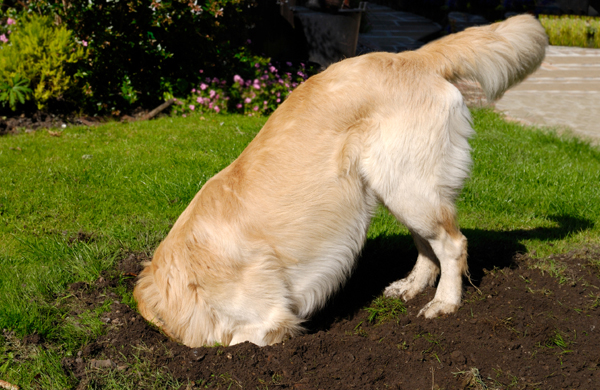
One of the biggest frustrations that comes with dog ownership is trying to establish how to stop dogs from digging. Our dogs bring lots of joy into our lives, but excessive digging problems can certainly put a strain on the owner-dog relationship.

How To Stop Dogs From Digging

Dogs dig for a number of reasons and it’s important to keep in mind that your dog is not digging to spite you. If you don’t clearly communicate to your dog that his digging is unacceptable behavior, he won’t even realize that he is doing anything “wrong”.

Why Do Dogs Dig Holes?

To learn how to stop dogs from digging holes it is crucial to determine the reason why your puppy or older dog is digging in the first place. Below is a list of the most common reasons your dog may be digging:

  • He simply likes to dig!
  • Your dog may just seeking your attention
  • May be bored and digs for mental and physical stimulation. What do you expect a bored, lonely and isolated dog to do?
  • If your dog is digging under the fence he may be trying to get out to search for a mate.
  • Dogs often dig in freshly turned dirt (like your rose bed!).
  • Dogs are often attracted to fertilized dirt – the smell of fertilizer is irresistible to some dogs.
  • To dig themselves a den – much as they would have in the wild.
  • Some breeds are very prone to digging (terriers, labradors), it is instinctual and bred into them.
  • May be because your dog is hunting for some little critters that live in your garden.
  • For food storage purposes. While you and me prefer to use the fridge, our dogs think the garden will do just fine.

How To Stop Dogs From Digging

Whenever you are trying to change any behavior in your dog the golden rule is to be consistent! Make it very clear to your dog what is, and is not acceptable behavior. Once you have determined the likely reason for your dog’s digging, you must then pinpoint the solution. Below is a list of proven techniques. If applied correctly they will help to control your dog’s digging problems.

  • He simply likes to dig!
  • Give your dog lots of exercise, including heaps of physical and mental stimulation. Your dog’s energy must be burned off in one way or another so why not channel it into something positive?
  • If your dog is always digging in order to bury a bone, don’t give bones! Substitute with chewing toys like rawhide bones. Confine your dog when you can’t supervise him. Place him in a crate, kennel run or indoors whenever you aren’t around to spy on him. You’ll need to do this until you have fixed the digging problem.
  • Blow up some balloons and bury them in the area your dog likes to dig. When he strikes a balloon, the noise of it popping startles your dog. In some cases the negative association this produces is enough to stop your dog from digging in the future. If you are able to be around your dog for a couple of days, you could have some success with this method. Whenever your dog starts to dig, reprimand him and spray him with the hose. Again this method produces a negative association to your dog each time he digs. You must perform this reprimand every time your dog starts digging holes for it to be successful.
  • If your dog has a favorite spot he likes to dig you can bury some chicken wire just under the surface of this area. When your dog starts to dig he won’t like the feeling of his paws scraping along the wire. I’ve used this method myself, and found that it worked well for my dalmation puppy who loved to dig!
  • This one doesn’t sound very nice but is a very popular and effective way to stop your dog from digging. What you do is fill up the holes your dog has created, adding some of his poop (feces) to the filling. Most dogs are really put off by this and won’t attempt to dig again. Some trainers advocate feeding your dog pineapple before performing this technique. Apparently the pineapple smells terrible when mixed with the poop.
  • Some dogs just copy what they see their owners doing. So if you’re working away in the garden, suddenly your dog may be interested in doing the same! Such dogs may need to be confined while you are working in the garden. This is probably another form of attention seeking behavior.
  • If you’ve got the room a great solution for both you and your dogs is to provide them with a digging area. You can actually encourage your dog to dig in this designated area. Fill it with nice soft sand and bury some of your dog’s favorite treats in it. Most dogs figure out that if they want to dig, they must go to this area. Check out this video which clearly shows how to create a digging area for your dog – dog digging box.
  • If your dog is digging under the fence it may be worth filling in all the holes in and under the fence. By blocking these outside distractions or triggers you take away the visual temptation that your dog may be trying to get at.
  • If you take a trip down to your local Pet Shop you will find many commercial products that claim to help digging problems. They are effective for some dogs and may be worth a try if you can’t manage the digging problem through training.
  • A couple of other methods you may want to try to control dog digging are to provide a few tasty chew toys for periods you are away from home and also employing a dog walker.

Good luck with stopping your dog from digging, and remember that basic dog obedience training is the key to correcting any dog behavioral problems. If your dog respects and trusts you, he will be eager to please you in all situations.

—————–

This article was brought to you by www.dog-obedience-training-review.com

Potty training for you and your puppy

Potty training for you and your puppy

People often say “I’ve done everything I could to teach my puppy bathroom etiquette and yet he/she still makes accidents. What else can I do to help my dog succeed without further frustrations?” I have received numerous requests to assist my clients with this daunting  task.

Where do we start then, assuming that every dog is at a completely different developmental stage? I try to explain to my clients that, no matter how much training they have done up to this point, we will either start from scratch or build and reinforce the foundation training that they have already started.
Puppies are definitely easier to train than older dogs as they haven’t had a chance to learn bad habits.  Also, we can treat puppies with the approach of a “blank slate ” reinforcing the newly learned behaviour. This is how I go about it.

A few things to cover before we start the actual training:

  1.  Communication

  •  Please  remember that you are trying to teach your dog a new skill in opposed to making them afraid of you. Soft and gentle assurance goes way further than screaming at your dog and yanking them around. So when you find yourself getting frustrated and ready to snap, simply put your dog away and take break.
  • Puppies need to go to the bathroom quite often; I would put them on a fairly strict schedule, more or less every 2 – 3 hours. What does it entail? When you wake up in the morning, you take them from their crate/enclosure straight to the bathroom, before letting them engage with you and make an accident. Remember it only takes them a split second to squat and make a pee.
  • Other important times that I would encourage you to take your puppy out is right before you stop playing with them, as it probably is the most common reason for accidents inside your house. You might also want to take them out 5 – 15 minutes after feeding. I hope this one is self explanatory.
  • What to do about occasional accidents? As much as possible ignore them, pick your puppy up and take them outside, showing them where to go. Please don’t rub their face in their own urine or poop, it doesn’t work.
  •  What name will you attach to this new behavior?  Various commands can be used. Here are some that I’ve heard so far:
    • Go pee
    • Go poo
    • Go potty
    • Hurry up
    • Go outside, etc.
  • I will allow myself to presume here, that most people will have some sort of a crate (soft or plastic one) for their puppy/grown dog. I will explain the reason for having a crate in step number three.

Once you make your choice remember only this. Consistency on your part will bring tremendous results!

2.  Where is your dog’s designated bathroom place?

  • My dogs go to bathroom on command and they always go to the same spot. I made a 6×6 sandbox, which I then filled with small rocks.  It’s easier to clean and sanitize the area. I know some people will fill the box with sand, fresh wood chips etc. Gravel works for me. Depending on your living conditions you will need to find a place that you will be able to use on a consistent basis.

3. Business time ‘Go potty’

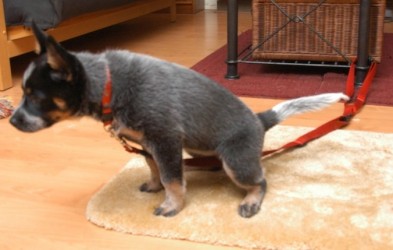
  • First we teach our dogs to go potty while on leash, so they learn that it isn’t up to them when and where they go. We have to step into the designated area with them and softly encourage them by using our “pre-planned command”. How long will it take the first time? Sometimes it doesn’t happen at all, that’s right NOTHING AT ALL! By then you are ready to simply quit. DON’T!
  • Assuming your dog refuses to go to the bathroom when you ask them to, you might need to stick around for a while and give them enough time to get at ease in the new area. If that doesn’t work, you simply take your dog (including picking them up if needed) and put them right back in their crate. Dogs are den animals and most of them do not like going to the bathroom where they sleep.
  • 15 minutes later we will repeat the first step over again. If you are strapped for time, you might just need to take them elsewhere, so you can proceed on your way. However, when you return home, you will need to go back to your regular schedule enforcement.
  • One of my dogs, Nika, was quite opposed to the idea of going to bathroom on gravel and refused to do so for three continuous days. I would still take her to her designated area prior to allowing her to go elsewhere. Although it would not be allowed in my backyard, not to give her any ideas that it was OK to do it between ‘cedar trees’ for example.
  • It was extremely frustrating at times. I think I stood with her on the gravel once for 45 minutes in the rain. That was Nika’s breaking point though. When she finally decided to go to the bathroom that day, I made a huge deal (mini celebration) out of it, to ensure she understood what it was all about.
  • The next week I continued to take her out on leash to ensure consistency and also, to instil in her mind, that it was the only place that she was allowed to use as a bathroom in my backyard. In total, it took us two and a half weeks of going outside together, before I tested if she was ready to go on her own.

Needless to say, it was a great feeling of accomplishment on my part, taking into consideration the fact that it rained for two weeks out of two and a half, while I was teaching Nika this skill. Now I can simply open the back door and ask my dogs to “go potty”.  Perseverance plays a a very important role in this entire process. Some dogs learn faster than others. One thing that they all learn fairly quickly is that we occasionally lack consistency and patience, which they often use to our detriment.

Yet again, I would not put a time frame on this process as the learning proccess is quite different for every dog out there. Also, I have tested this process with both, puppies and fully grown dogs and it works! My dogs learned this skill in the span of 2 – 3 weeks of consistent practice and so can yours. Brace yourself with patience and please let me know if it worked for you too.